

Quick answer
For most Singapore offices printing over 200 pages a month, genuine high-yield (XL) toner cartridges deliver the lowest cost per page and protect your printer warranty. Compatible toners can save 30 to 40 percent upfront but risk warranty void and inconsistent print quality on critical documents.
Standard or XL? Genuine or compatible? We answer the four questions every Singapore office manager should run through before placing the next toner order, including the cost-per-page sum that settles most of them and the warranty fine print most resellers leave out.
Toner is one of the few office spend lines where the obvious choice is rarely the right one. The cheapest cartridge on the shelf almost never has the lowest cost per page, and the most expensive one is sometimes a waste of budget. The trick is matching the cartridge to your real-world print volume, not the printer's spec sheet.
Step 1: Know your true monthly page volume
Before you can choose a cartridge, you need an honest number for how many pages you actually print each month. Pull the page count from your printer's web admin (most show lifetime and 30-day counts under Settings or Reports), then divide by the months the printer has been in service.
If the number surprises you, that is normal. We routinely see offices that thought they printed 500 pages a month land at 2,000 once you add up the contracts, the meeting handouts, and the inevitable PDFs that someone insists on printing. Use this honest baseline for the maths in Step 3.
Step 2: Standard versus XL (high yield)
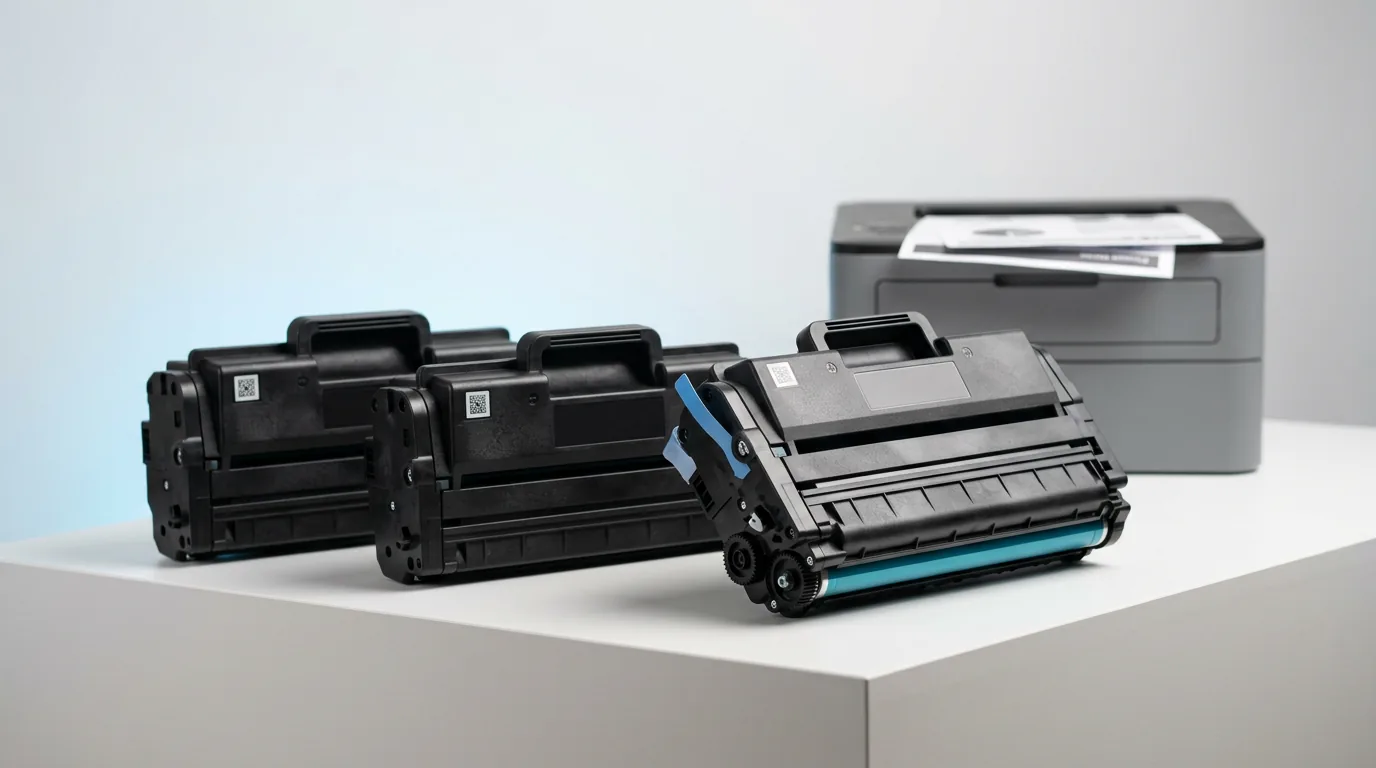
Almost every laser printer has two cartridge sizes. The standard cartridge has a lower upfront price but a higher cost per page. The XL or high-yield cartridge costs more, sometimes a lot more, but contains two to three times the toner.
The number that matters is cost per page, not the price on the box. Divide the cartridge price by its rated page yield, then run the same sum on both sizes using today's quoted prices. The answer is usually obvious once you see it side by side.
Take the HP 26A and 26X. HP rates the 26A at 3,100 pages and the 26X at 9,000 pages, so the high-yield cartridge holds close to three times the toner. Unless it is priced at close to three times the standard cartridge, it wins on cost per page, and you are changing cartridges a third as often. Ask us for both prices on your model and we will do the sum with you.
Buy XL by default unless your printer sees almost no use. The reordering admin time alone justifies it for most SMEs.
Stanley Chua, Managing Director
Step 3: Genuine OEM versus compatible toner
This is the question every procurement team eventually asks, usually after a finance review. Compatible toners (made by third parties to fit your printer) are meaningfully cheaper up front. The question is whether the saving survives contact with the four things below.
- Warranty exposure. HP, Canon, and Brother Singapore all reserve the right to void warranty cover if a non-genuine cartridge causes printer damage. In practice, mainstream compatibles rarely cause damage, but if they do, you are uncovered.
- Print consistency. Compatible toner formulations vary batch to batch. For internal documents, this is usually fine. For client-facing proposals, compliance reports, or anything you would scan and email to a customer, the inconsistency shows.
- Page yield reality. A compatible cartridge quoting the same nominal yield as the OEM often does not deliver it. Work out cost per page on what you actually get, not the number on the box, or the saving can quietly disappear.
- Drum and fuser wear. Aggressive compatible formulations can shorten drum life on some models. We have replaced drums well ahead of schedule for offices that switched to the cheapest compatibles they could find, which wipes out the cartridge saving in one go.
Step 4: Match the SKU exactly
More toner is wasted on wrong-SKU orders than on any other procurement mistake. The HP 58A and 58X share a number but are not interchangeable across printer families, and at least four different cartridges are stamped with HP 415A across the colour LaserJet range.
Browse our toner and ribbon range and search your exact printer model to find the matching cartridge. If you maintain a fleet of mixed brands, we can build you a printable matching matrix for the office stationery cabinet. Just request it through your account manager or the quote and account form.
Buying in Singapore: stock, GST, and lead time
We carry a deep toner and ribbon range from our PRIMAX warehouse, covering active models across HP, Canon, Epson, Brother, Fujifilm, and OKI. Every price on our site is GST-inclusive, so there is no surprise at checkout. Orders placed before 3pm SGT dispatch the next business day, and delivery across the island is free above S$150.
For B2B and government buyers, we offer monthly invoicing, panel-agreement pricing, and managed reorder schedules so you never run out mid-month. Browse the full ink, toner, and ribbon catalogue, or look at the brand-specific ranges from HP and Brother for the most popular SKUs.
Frequently asked questions
Are compatible toner cartridges safe to use in my office printer?
Mainstream compatibles from established brands are generally safe and we sell some ourselves, clearly labelled. Avoid unbranded marketplace compatibles. Always check whether your printer is still under warranty before deciding.
How do I find my exact toner cartridge model?
Open the front door of your printer and slide out the existing cartridge. The model code is printed in large type on the cartridge body. You can then search that code in our toner and ribbon range to find the exact match.
Do you stock toner for older Singapore office printers?
Yes. We stock cartridges for printers as old as the HP LaserJet 1018 (2006) and the Brother HL-2240 (2010). Email procurement@cloverglobal.com.sg with your model and we will confirm availability and lead time.
What is the difference between A and X in HP cartridge codes (for example 26A versus 26X)?
A is the standard yield, X is the high-yield (XL) version of the same cartridge. The X has the same physical fit but holds two to three times more toner, with a lower cost per page.